Do U Have to Upload Htaccess to Godaddy Using Word Press
Mar 17, 2022
Volition M.
7min Read
How to Use SSL and HTTPS on Your WordPress Site (The Right Way)

If you run a website, there may exist people who trust their personal information to you. That means you need to enforce solid security standards, and both Secure Sockets Layer (SSL or TLS) and Hypertext Transfer Protocol Secure (HTTPS) play an essential role in making that happen. Luckily, setting upwards a WordPress SSL certificate and enforcing HTTPS on the platform is adequately simple, and can exist washed in simply a few steps.
Download eBook: Speed Upward Your Website. 8 Applied Tips That Work
In this article, we'll talk near:
- What SSL is and when you should employ it.
- What HTTPS is, and how information technology works alongside SSL.
- How to configure WordPress to employ HTTPS and SSL via two dissimilar methods.
- Two common errors you can meet when using SSL with WordPress, and how to deal with them.
We have an of import subject to tackle and a lot of ground to cover, so let's dive correct in!
What SSL Is (And When You Should Employ It)
Secure Sockets Layer (SSL) is a technology that creates a secure connection betwixt a website and a browser. Websites that use SSL have 'certificates' that let yous know your private data is safe during each transfer.
Y'all can recognize most sites that use these certificates, due to the green lock symbol many browsers use to place them:

For example, if you're purchasing something online, you should simply practice so through websites that use SSL. Otherwise, attackers might be able to read or change your payment information as it's sent across the spider web.
Equally for your own website, using SSL is a must. There are a number of benefits to doing this:
- If yous run a website where you encourage users to register and share private information, their information volition exist safer.
- Your website volition be more than trustworthy.
- An awesome green lock will prove up next to your spider web address in various browsers.
- You lot'll receive a heave to your site's Search Engine Optimization (SEO).
To elaborate on that terminal point, search engines similar Google encourage all websites to employ SSL, by giving secure sites preference in their results. That ways you lot become to protect your users' information and possibly benefit from some more traffic in one fell dive.
In addition, Google announced that Chrome will display a "not secure" warning since the showtime of July 2018. And then it'southward a bully time to enforce your website's security with an SSL certificate if you haven't already.
These days, setting up a WordPress SSL document is downright simple. There are several types of SSL certificates, just you probably won't need anything fancy unless you're running a sizable website or selling products online.
For all other types of websites, a free certificate volition usually practice the job. What's more than, you can hands set one upward to piece of work with Hostinger.
What HTTPS Is (And How It Works Alongside SSL)
When you set up an SSL certificate for your website, you lot'll also need to configure it to transmit data using Hypertext Transfer Protocol Secure (HTTPS). Every site yous visit uses either HTTP or HTTPS as a prefix for its full URL, including Hostinger:

HTTPS works just like HTTP, but it enforces college security standards. If you load a website that uses HTTPS, you'll know your information is secure during the transfer. However, in order for HTTPS to work, the website you're trying to access needs an SSL certificate.
If you try to access a site without SSL using HTTPS, y'all'll see an error similar this one:
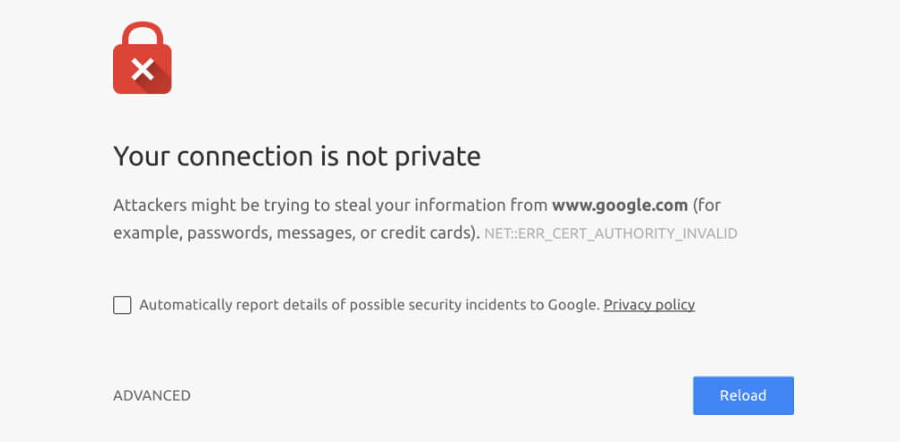
In other words, SSL and HTTPS work hand-in-hand. If you simply use ane, the information users send through your website won't exist secured.
Your first move, therefore, should be to get an SSL certificate and set up it up to work with your website. Once y'all accept that, yous need to tell WordPress to load using HTTPS instead of HTTP. Let's accept a look at how that process works.
How to Configure WordPress to Use SSL and HTTPS (2 Methods)
At this betoken, we're going to presume that you lot already accept an SSL certificate set upwardly for your website. Once you've done that, you lot merely need to forcefulness WordPress to utilise HTTPS. At that place are two principal ways to practise that.
ane. Apply the WordPress Dashboard and a 301 Redirect
Once you lot have a WordPress SSL certificate set, you need to configure your website to apply HTTPS. This process is uncomplicated if you lot're starting a new website. Notwithstanding, if yous're calculation an SSL document to a site that'southward been around for a while, it'due south a bit more complicated.
In whatever case, your first step should be to get to your dashboard and open up upwards theSettings › Generaltab. Inside, you'll find two fields calledWordPress Accost (URL)andSite Address (URL). Your website'southward accost should appear identical in both, and should utilize HTTP.
What you lot need to do is replace thatHTTPprefix withHTTPS in both fields, and salvage the changes to your settings:

That's all information technology takes to configure WordPress to use HTTPS. However, some users might have saved your website'due south old URL, and it may be linked to beyond the web. Y'all need to make sure those people make it to the HTTPS version of your site instead. To exercise that, you tin set up a URL redirect.
There are many types of redirects yous can use. However, yous're mostly all-time off using a 301 redirect, which tells search engines that your website has moved permanently from ane accost to another. To implement this redirect, yous need to edit a file chosen.htaccess, which controls how your server interacts with WordPress, as well every bit its URL construction.
This will crave y'all to access your site's files directly, using a File Transfer Protocol (FTP) tool such as FileZilla. If information technology'due south your first time doing this, you tin can find all the details in our FTP guide.
One time you connect to your website via FTP, navigate to thepublic_htmlfolder and await for the.htaccessfile within:

Select that file and correct-click on it, then choose theView/Editchoice. This volition open the file using your local text editor, enabling y'all to make changes to it. Don't change any of the code inside.htaccessunless you know what you're doing. Just roll to the very bottom of the file, and paste in the following snippet:
<IfModule mod_rewrite.c> RewriteEngine On RewriteCond %{SERVER_PORT} 80 RewriteRule ^(.*)$ https://www.yoursite.com/$i [R,Fifty] </IfModule> For this to work, you'll need to replace the placeholder URL in this code with your website's full HTTPS accost. This will redirect whatsoever connection that comes through port 80 to your new, secure URL. As you may know, port 80 is the default for HTTP connections, and so this will catch just about anyone trying to access your website through the one-time address.
Once you lot've added the code with your URL, save your changes to.htaccessand close the file. FileZilla will enquire if you want to upload those changes to your server, which you'll want to agree to. If you lot try visiting your website using the HTTP URL now, your browser should automatically redirect you to the HTTPS version instead.
two. Install a WordPress SSL Plugin
If you'd rather not work straight with your WordPress files, there are easier means to enforce HTTPS utilise throughout your website. For example, you tin fix up a WordPress SSL plugin, which adds the same code we showed you lot in the previous method.
While this approach is much simpler, it also comes with some added adventure. For example, if compatibility issues arise with another tool, your SSL plugin could terminate working and your website won't load over HTTPS until you ready the issue. That means you'll want to choose your plugin carefully.
We recommend Really Simple SSL, since it's remarkably easy to ready. All y'all need is a WordPress SSL certificate ready to go:
Once you install and enable the plugin, information technology volition scan your website for a WordPress SSL certificate. If it finds one, it will assist you enable HTTPS throughout your unabridged site with a single click. To do this, just visit the newSettings › SSLtab in your dashboard, and click on theReload over HTTPSbutton. With that, you lot're good to go!
If the Actually Uncomplicated SSL plugin isn't your loving cup of tea, there are alternate tools you can use to attain the same results. Other excellent WordPress SSL plugin options include WordPress HTTPS (SSL) and Force HTTPS.
ii Mutual WordPress SSL Errors (And How to Fix Them)
At this point, you know how to brand sure all visitors to your site get to take advantage of a secure connexion. In some cases, even so, forcing WordPress to load over HTTPS can atomic number 82 to a couple of errors. Allow's talk well-nigh what they are and how to fix them, just in case.
1. Some Assets Aren't Loading Over HTTPS
After enabling HTTPS for your website, you might find that some of its assets, such as images, aren't loading properly. That's considering WordPress is still using the HTTP prefix for them instead of HTTPS.
If you lot notice yourself having this trouble with your site's images, CSS, or JavaScript, the easiest way to solve it is to make a few additions to your.htaccessfile. Nonetheless, this approach only applies if you used the manual method during the previous section. We'll talk about what to do if yous used a plugin instead in a minute.
Access your website via FTP once again, and look for the.htaccessfile within thepublic_htmldirectory. Open information technology up, and find the code you added before to force a 301 redirect, which should look like this:
<IfModule mod_rewrite.c> RewriteEngine On RewriteCond %{SERVER_PORT} 80 RewriteRule ^(.*)$ https://world wide web.yoursite.com/$1 [R,L] </IfModule>} What you're going to practice is delete that snippet and supplant it with one that's more thorough. This isn't necessary in most cases, since it isn't that common to have bug with some assets non loading properly. Notwithstanding, if yous are having this problem, here's the code yous should use instead:
<IfModule mod_rewrite.c> RewriteEngine On RewriteCond %{SERVER_PORT} !^443$ RewriteRule (.*) https://%{HTTP_HOST}%{REQUEST_URI} [R=301,L] RewriteBase / RewriteRule ^index\.php$ - [Fifty] RewriteCond %{REQUEST_FILENAME} !-f RewriteCond %{REQUEST_FILENAME} !-d RewriteRule . /index.php [Fifty] </IfModule> What this code does is force all traffic to load over HTTPS. It also includes rules for your WordPress assets, so it should have intendance of all the files that weren't working. After adding it in, salve your changes to the.htaccess file and upload information technology back to the server.
If y'all configured your website to use HTTPS via a plugin, you shouldn't demand to tweak your.htaccessfile manually. Instead, most plugins volition offer an alternative solution. For example, Actually Simple SSL can scan your website for files non loading over HTTPS, and help you fix them. To employ this feature, become to yourSettings › SSLtab, and and then navigate to the plugin'southSettingsfolio:

At that place's a setting calledMachine supervene upon mixed contentright at the elevation of the screen. Brand certain it's enabled, and then save your changes to the plugin's configuration. This pick volition ensure that WordPress loads all its assets over HTTPS, and not merely your posts and pages.
ii. Your WordPress Caching Plugin Is Causing Bug
If you have a WordPress caching plugin set upwards, your browser might try to load your website's buried version over HTTP, which tin atomic number 82 to some errors. The quickest way to solve this problem is to articulate your WordPress cache.
The way this process works will vary, depending on which caching plugin yous use. However, it shouldn't accept you lot more than a few minutes. For more details, you can check out our guide on how to clear your WordPress cache in WP Super Cache, W3 Total Cache, and WP Fastest Enshroud. If yous're using some other caching plugin, y'all may demand to check its documentation for instructions on how to proceed.
In any case, once yous clear your enshroud, try loading your website once again to ensure that your browser is using HTTPS without any errors. Your SSL certificate is now successfully gear up!
Conclusion
It used to exist the case that WordPress SSL certificates were reserved for business websites, which dealt with a lot of sensitive data. These days, SSL certificates and HTTPS have become commonplace. In fact, search engines such as Google encourage you to employ them. Fortunately, as you've seen, implementing SSL and forcing your WordPress site to employ HTTPS isn't a difficult chore.
Do you have any questions about how to utilise WordPress SSL and HTTPS? Allow'due south talk about them in the comments section below!

Volition Morris is a staff writer at WordCandy. When he's non writing near WordPress, he likes to gig his stand-upwardly comedy routine on the local circuit.
Source: https://www.hostinger.com/tutorials/wordpress-ssl/
0 Response to "Do U Have to Upload Htaccess to Godaddy Using Word Press"
Post a Comment