Review of Disk and Washer Method Ap Calculus Worksheet Answers

AP Calculus Review: Disk and Washer Methods
The disk and washer methods are useful for finding volumes of solids of revolution. In this article, we'll review the methods and work out a number of instance bug. Past the end, you'll be prepared for any deejay and washer methods issues you encounter on the AP Calculus AB/BC exam!
Solids of Revolution
The disk and washer methods are specialized tools for finding volumes of sure kinds of solids — solids of revolution. So what is a solid of revolution?
Starting with a apartment region of the aeroplane, generate the solid that would be "swept out" as that region revolves around a stock-still centrality.
For example, if you beginning with a correct triangle, and then revolve it around a vertical axis through its upright leg, then you get a cone.
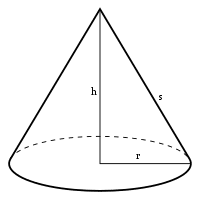
The cone generated every bit a solid of revolution past revolving a right triangle around a vertical axis
Here's another cool example of a solid of revolution that you might have seen hanging up as a decoration! Tissue paper decorations that unfold from apartment to round are examples of solids of revolution. Watch the next few seconds of the video below to run across how it unfolds in real fourth dimension.
The Disk and Washer Methods: Formulas
And then at present that you know a bit more about solids of revolution, let's talk nearly their volumes.
Suppose S is a solid of revolution generated by a region R in the plane. There are two related formulas, depending on how complicated the region R is.
Deejay Method
The simplest case is when R is the surface area under a curve y = f(x) between x = a and x = b, revolved around the x-axis.
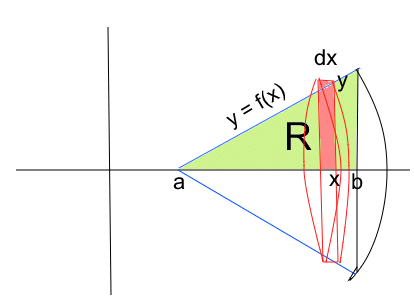
Now imagine cutting the solid into thin slices perpendicular to the x-centrality. Each slice looks similar a deejay or cylinder, except that the outer surface of the disk may have a curve or camber. Permit'due south approximate each piece by a cylinder of height dx, where dx is very small.
In fact, I like to think of each disk as existence generated by revolving a thin rectangle around the x-centrality. So y'all tin can see that the height of the rectangle, y, is the same every bit the radius of the deejay.
Now let's compute the volume of a typical disk located at position x. The radius is y, which itself is just the function value at 10. That is, r = y = f(10). The top of the deejay is equal to dx (call up of the disk equally a cylinder standing on edge).
Therefore, the volume of a single cylindrical disk is: V = π r 2 h = π f(x)two dx.
This adding gives the approximate volume of a thin slice of Southward. Next, to approximate the book of the entirety of S, nosotros have to add up all of the deejay volumes throughout the solid. For simplicity, presume that the thickness of each slice is constant (dx). Also, for technical reasons, we take to keep track of the various 10-values along the interval from a to b using the note tenk for a "generic" sample bespeak.
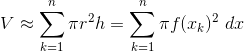
Finally, by letting the number of slices go to infinity (by taking a limit equally n → ∞), we develop a useful formula for volume as an integral.

Case 1: Deejay Method
Let R exist the region under the curve y = iix iii/2 betwixt x = 0 and x = 4. Find the book of the solid of revolution generated past revolving R around the x-axis.
Solution
Let's ready the disk method for this trouble.
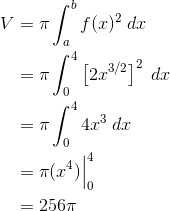
The volume of the solid is 256π (roughly 804.25) cubic units.
Washer Method
Now suppose the generating region R is bounded past two functions, y = f(x) on the top and y = g(x) on the bottom.
This time, when y'all circumduct R around an axis, the slices perpendicular to that axis will look similar washers.
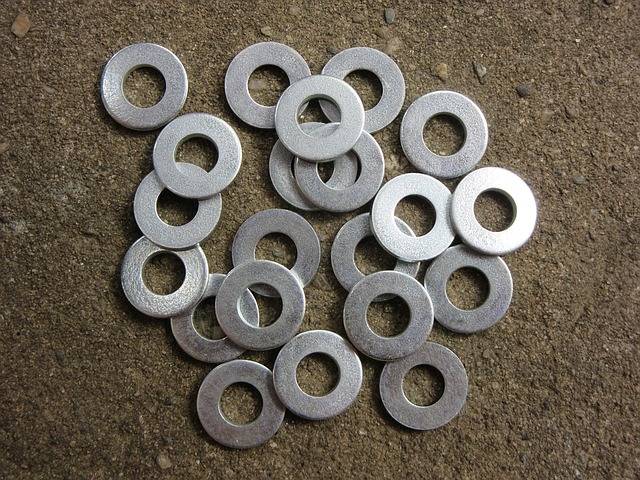
No, nosotros're not talking near apparel washers or dishwashers…
A washer is like a disk but with a center hole cut out. The formula for the volume of a washer requires both an inner radius r 1 and outer radius r 2.
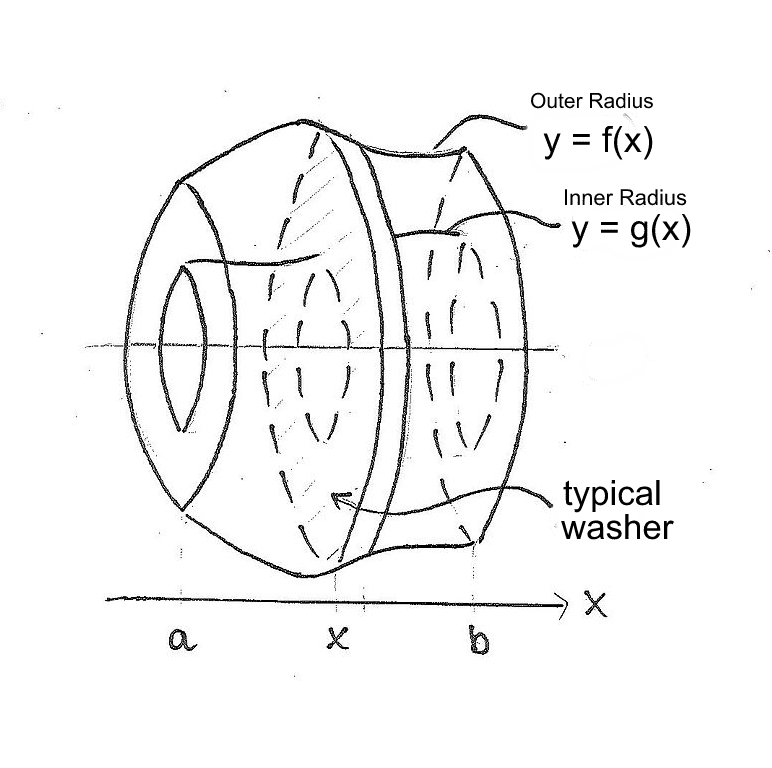
Nosotros'll demand to know the volume formula for a unmarried washer.
V = π (r 2 2 – r 1 two) h = π (f(x)two – g(x)2) dx.
As before, the verbal volume formula arises from taking the limit as the number of slices becomes space.

Example 2: Washer Method
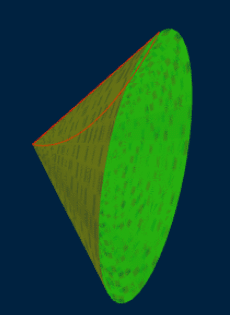
Decide the book of the solid. Hither, the bounding curves for the generating region are outlined in red. The top bend is y = ten and the bottom one is y = x two
Solution
This is definitely a solid of revolution. We'll fix the formula with f(ten) = x (top) and 1000(x) = x 2 (lesser). But what should we use as a and b?
Well, merely as in some expanse problems, you may have to solve for the bounds. Clearly the region is divisional by the two curves between their common intersection points. Set f(10) equal to 1000(x) and solve to locate these points of intersection.
x = 10 2 → x – x ii = 0 → 10(i – ten) = 0.
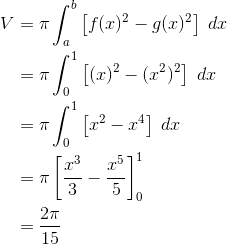
We find two such points: x = 0 and 1. So set a = 0 and b = 1 in the formula.
Example 3: Different Axes
Set up an integral that computes the volume of the solid generated by revolving he region divisional by the curves y = x two and x = y iii around the line x = -1.
Solution
Be careful not to blindly use the formula without analyzing the situation start!
This time, the axis of rotation is a vertical line x = -1 (rather than the horizontal 10-axis). The radii will be horizontal segments, and so think of x 1 and x 2 (rather than y-values).
Furthermore, because everything is turned on its side compared to previous issues, we accept to brand sure both purlieus functions are solved for x. The thickness of the washer is now dy (instead of dx).
Finally, because the axis of revolution is one unit to the left of the y-axis, that adds another unit to each radius. (The further abroad the axis, the longer the radius must be to reach the figure, correct?) Take a look at the graph below to assistance visualize what's going on.
- Inner Radius: x = y 3 + 1
- Outer Radius: ten = y 1/ii + ane
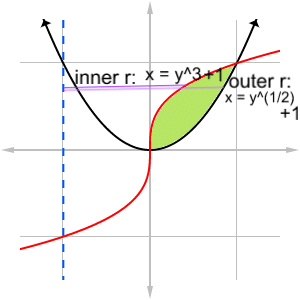
As before, gear up the functions equal and solve for points of intersection. Those are over again at x = 0 and 1.
Using the Washer Method formula for volume, we obtain:
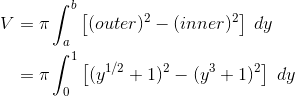
The trouble but asks for setup, and then we are washed at this point.
By the mode, Magoosh can aid y'all study for both the SAT and ACT exams. Click here to learn more!
Source: https://magoosh.com/hs/ap/ap-calculus-review-disk-washer-methods/
0 Response to "Review of Disk and Washer Method Ap Calculus Worksheet Answers"
Post a Comment